
The Minnesota Iceman: Frozen Hominid or Carnival Fake?

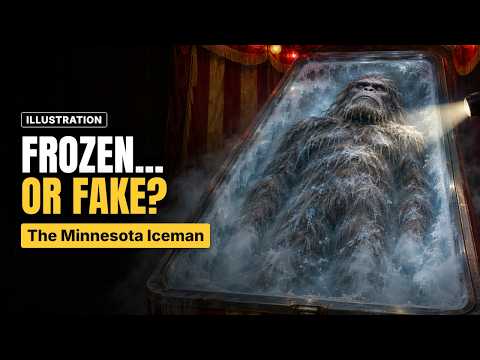
Video: The Minnesota Iceman: Frozen Hominid or Carnival Fake?
By Dr. Elizabeth Harper, Cryptozoologist
Picture a traveling sideshow in the late 1960s. You hand over a small fee and look down at a hairy, human-shaped figure displayed under glass and ice. One eye looks wrong. A forearm seems bent where no forearm should bend. That's the Minnesota Iceman. In the late 1960s the exhibit drew the attention of investigators Bernard Heuvelmans and Ivan T. Sanderson, and the Smithsonian Institution later sought FBI help locating its owner.
I don't think a Neanderthal toured county fairs. I still love this case, because it's a clear lesson in the gap between seeing something and knowing what it is. The Iceman is real as an object. What it actually was is the fight worth having.
What the Minnesota Iceman Actually Was

The Iceman was a hairy, human-shaped figure that exhibitor Frank D. Hansen displayed in a refrigerated, glass-topped case. Zoologist Darren Naish's history describes how it was presented as the complete carcass of a hirsute male hominid about 1.8 meters tall, hauled around the United States as a traveling show. The Smithsonian's own staff newsletter gave a similar picture: roughly six feet tall, with oversized hands and feet.
The Minnesota Iceman, 1967 to 2026
Sourced data: each entry cites a numbered source listed below.
-
May 3, 1967 – Model debut claimed at Los Banos
Hansen later said a model debuted at Los Banos, California. The exhibitor himself places an artificial figure at the start of the story.
Sources: [6]
-
December 1968 – Heuvelmans and Sanderson inspect the exhibit
The two investigators examine the figure at Hansen's home in Rollingstone, Minnesota. This inspection became the foundation of their biological conclusions.
Sources: [4]
-
1969 – Homo pongoides proposed
Heuvelmans proposes the name Homo pongoides in a preliminary paper. A published hypothesis, not an authenticated animal.
Sources: [4]
-
April 1969 – Smithsonian has asked the FBI for help
The Smithsonian's April newsletter reports that Secretary Ripley has asked J. Edgar Hoover to help identify and locate the owner, and that Napier's request to examine the figure was refused.
Sources: [3]
-
May 8, 1969 – Smithsonian declares it a latex model
A Smithsonian statement withdraws interest and describes the figure as a carnival exhibit of latex rubber and hair.
Sources: [5]
-
July 1970 – Hansen's Saga account
Hansen publishes a shooting story and admits commissioning a model. One article, two incompatible kinds of claim.
Sources: [6]
-
June 26, 2013 – Iceman resurfaces in Austin
The Museum of the Weird announces owner Steve Busti has the figure, with a public return planned for July 3. The Iceman gets a museum afterlife.
Sources: [1]
-
February 2026 – Still shown as "The Creature in Ice"
A Spectrum News profile describes the exhibit as "The Creature in Ice," Busti's favorite at the Museum of the Weird.
Sources: [2]
Notice what those numbers are. They're descriptions of an exhibit. Nobody ever got the figure onto a dissecting table and measured an animal.
That's the distinction I want you to carry through everything below:
- The attraction existed. That part is thoroughly documented.
- Its identity as a biological specimen was never established. That part stayed locked behind glass and ice.
You can accept the first without swallowing the second. Honestly, the case gets more interesting when you do.
The timeline above runs from the model debut Hansen claimed for 1967 to the figure's display in Austin in 2026.
December 1968: Why Two Serious Investigators Believed

It would be easy to sneer at the men who looked at a carnival gaff and saw a corpse. I won't, because they did real work.
According to Bernard Heuvelmans's preliminary paper in the Belgian Royal Institute's bulletin, on Saturday, December 14, 1968, Ivan T. Sanderson invited him (then staying as Sanderson's guest in New Jersey) to travel to the Midwest and examine the corpse of a hairy, human-looking being encased in ice. Heuvelmans centers his first look on December 17.
Sanderson's version, in the Argosy magazine material from May 1969, puts the visits across December 16 to 18. He says the two men examined the figure together and separately, wrote independent reports, and compared notes afterward. That's more method than most carnival visitors bring to a two-headed calf.
What did they see? Naish's account summarizes Heuvelmans's description: a broad, flattened face, heavy brow ridges, a thick neck, a powerful torso, and enormous extremities. They also saw what looked like injuries. One eye appeared displaced. A forearm seemed bent. They read those as signs of a shooting and broken bones, and that reading made the thing look like a damaged body instead of a tidy sculpture.
The Smell Near the Case
Heuvelmans also reported an odor near the case that he identified as a decomposing corpse. I understand why that rattled him. Smell hits the gut before the brain gets a vote.
But an odor is an observation, and "rotting hominid" is an interpretation. A refrigerated sideshow case has plenty of ways to stink. The smell tells you nothing about what's under the skin of the shape in the ice.
The Ice Was the Real Problem
Here's where Sanderson deserves credit for his honesty. In his technical paper in the Italian journal Genus, describing the external morphology of the Iceman, he states that the figure sat sunk beneath glass, that the ice was more than half opaque, and that real identification would require freeing the body and examining it properly.
He concluded it was a genuine corpse. In the same breath, he refused to make a definite identification beyond a general description of its outside.
Think about trying to identify someone through a frosted bathroom window. Two people can agree perfectly on the blurry silhouette. Comparing their notes won't sharpen the glass. Independent sketches improve the record of what was visible, but they can't remove an obstruction both observers share.
Their caution deserves as much attention as their excitement. The investigators themselves named the missing step. Nobody ever took it.
Hansen's Origin Stories Don't Fit Together

If you want a strange specimen taken seriously, you need its chain of custody: where it was collected, who handled it, and whether the object on display stayed the same object. Hansen gave answers. He just kept giving different ones.
Four origin accounts compared
Sourced data: each entry cites a numbered source listed below.
| Origin story | Who told it | Evidential status | Sources |
|---|---|---|---|
| Found in sea ice off Kamchatka, later surfacing in Hong Kong | Hansen, implying a Russian sealer found it (Smithsonian newsletter, April 1969) | A reported acquisition story, never documented | [3] |
| Shot near Whiteface Reservoir, Minnesota, during the 1960 deer season | Hansen's later account | His claim, with no independent corroboration | [2][4] |
| Smuggled out of Vietnam | Heuvelmans's own reconstruction, which Naish calls speculative | An investigator's theory, not exhibitor testimony | [1] |
| A commissioned model | Hansen, who then claimed a real body replaced it in 1968 | The model is admitted; the swap is unsupported | [4] |
Naish notes that the exhibit was first marketed as the "Siberskoye creature," in the classic "Is it real? You won't believe your eyes!" fairground tradition. From there, the story forked into the four accounts compared above.
These aren't chapters of one adventure. A sealer's find, a Minnesota shooting, and a Vietnam smuggling run each require different witnesses, places, and paperwork. Stack them up as equally likely and you hide the case's biggest weakness: nobody can say where the supposed body came from.
The Whiteface Shooting Story
The Museum of the Weird has posted Frank Hansen's story of the Minnesota Iceman, the version set near Whiteface Reservoir. The full text appeared in Saga in July 1970 as "I Killed the Ape-Man Creature of Whiteface", and it reads like a pulp horror script.
In Hansen's telling, he followed a wounded doe into a swamp and saw two hairy creatures scooping blood from a deer with human-like hands while a third crouched nearby. The third, a male, charged, screeching. Hansen said he could not remember pulling the trigger. Weeks later, after fresh snow, he says he returned with his dog Mike and a swamp buggy, tripped over the frozen body, chopped it out of the ground with an ice chisel, and put it in his family's recently purchased freezer. His stated motive for secrecy was fear for his upcoming Air Force retirement.
Gripping stuff. Now look at what else sits in that same article. Hansen admitted using a false Bering Straits cover story. He admitted commissioning a model and exhibiting it first. Then he claimed the real body later took the model's place.
It's like a used-car salesman saying, "Sure, I rolled back the odometer, but the engine's straight out of a Ferrari." The confession is useful. The sales pitch attached to it can't vouch for itself.
So keep two buckets separate. The manufactured figure is acknowledged by the exhibitor himself. The researchers believed they saw a corpse, but Hansen's claimed substitution has no independent corroboration.
Who Actually Made the Iceman?

The strongest case for fabrication isn't that the Iceman looks odd. Lots of real animals look odd. It's that independent lines of evidence about its manufacture point the same direction.
In Saga, Hansen named names:
- Howard Ball as the sculptor and mold-maker
- Pete and Betty Corral as the workers who implanted the hair, strand by strand
He said the model copied the supposed original's injuries and was frozen into a refrigerated display.
Primatologist John Napier, writing in 1973, added the institutional side. In his firsthand account of the Smithsonian's Iceman investigation, he recalls that George Berklacy of the Smithsonian's public relations office tracked down a West Coast company that claimed it had built the Iceman for Hansen out of latex rubber and hair in April 1967. The name Pete Corrall came up. Napier and Berklacy sat on it, then saw no reason to keep quiet once Hansen named Corral himself in Saga.
And here's a detail I adore, because it shows Napier being careful. He admitted there was no proof the company's story was true. Sanderson later told him at least two other outfits claimed the same honor. When at least three outfits claim credit for building one sideshow exhibit, that's a peculiar kind of fame. Still, the company's account matched Napier's growing conviction that the Iceman was a model and always had been.
Napier Was Refused Access
This one gets garbled in some retellings. You'll read that Napier inspected the Iceman and spotted latex on sight. The record says otherwise.
The Smithsonian's staff newsletter The Torch, April 1969, says plainly that Napier asked permission to examine and study the creature, was refused, and as of that issue had not seen it.
The same newsletter lists the options he was weighing:
- A manufactured artifact
- An abnormal human cadaver
- An unknown species of human or ape
He considered the last option least likely but said scientists should keep an open mind. That's not blind belief and it's not a slammed door. It's a man trying to get the access he needed to tell the possibilities apart.
What the FBI Letter Actually Means
Yes, the Smithsonian contacted the FBI. By April 1969, Secretary S. Dillon Ripley had asked J. Edgar Hoover for help identifying and locating the owner, so the Institution could determine whether the Iceman was a hoax or a major scientific find. That's a request for help finding a man. It's not a federal stamp on a new species.
The reply was a shrug. Napier recalls Hoover pointing out that no violation of federal law had been shown, so the Bureau had no power to act. Sanderson had already tried the New Jersey FBI office on his own and, in Napier's words, "received a dusty answer."
Then the curtain dropped. A Smithsonian statement dated May 8, 1969, reproduced with the Argosy material, withdrew the Institution's interest, described the figure as a carnival exhibit of latex rubber and hair, and rejected the whole idea of a genuine original versus a substitute. Napier says the release went out on his advice, partly to spare everyone headlines reading "Smithsonian Scientists Fooled by Carnival Exhibit."
Napier's lack of direct access limits what he personally observed. It doesn't erase the separate evidence of manufacture, and it isn't positive evidence for a hidden corpse.
The Swap Theory and the Neanderthal Theory Are Different Questions

People tend to bundle these together. They shouldn't.
- The replacement theory asks: did investigators see a real body before a model took its place?
- The Neanderthal theory asks: if there was a body, what was it?
Proving one wouldn't prove the other. Bundling them makes the case look tidier than it ever was.
Photographs taken at different times show visible differences, including whether the teeth are exposed. Some supporters treated that as proof of a switch. Naish points out a simpler possibility: thawing and refreezing can shift a model's pose and appearance. Different photos don't have to mean two different objects.
Heuvelmans Rejected the Swap
This surprises a lot of people. According to Naish's review of Heuvelmans's later book, Heuvelmans didn't accept the standard replacement defense. He insisted the later figure was the same real corpse, repositioned after a thaw and refreeze.
So the Iceman's two chief champions didn't share one story, and neither of them simply signed on to Hansen's. I find that more revealing than any photo comparison.
A Name Is Not a Species
Heuvelmans's paper proposed the scientific name Homo pongoides. Sanderson explicitly distanced himself from that label and declined to place the figure confidently in any human or ape lineage. They agreed it was a corpse. They didn't agree on what kind.
The anatomy fights the Neanderthal idea too. Naish notes that the figure's proportions, especially its long, slender thumb, sat awkwardly with Heuvelmans's argument. Patching those mismatches with an undocumented line of continuing Neanderthal evolution adds assumptions without adding observations.
Compare that with how real Neanderthals are known. The Smithsonian's Human Origins Program page on Homo neanderthalensis builds its picture from fossils and genetics and places their disappearance at about 40,000 years ago. Looking like a museum diorama caveman doesn't connect a frozen figure to that evidence.
For a sympathetic view, read anatomist Jeff Meldrum's review of Heuvelmans's Neanderthal: The Strange Saga of the Minnesota Iceman in the Journal of Scientific Exploration. He stresses the investigators' credentials and the detail of their descriptions, while conceding the question of a flesh-and-bone hominid stayed unresolved without the body. He also warns readers not to confuse the Iceman with a much later stunt by Rick Dyer and Matt Wheaton, whom he calls charlatans, in which a supposed Bigfoot carcass was frozen in ice. Fair warning. The 1968 investigators were serious people, even where I think they were wrong.
Where Is the Minnesota Iceman Now?

The Iceman toured for years and then dropped out of sight. On June 26, 2013, Austin's Museum of the Weird announced that the long-lost "frozen caveman" had resurfaced in owner Steve Busti's possession, with a public return planned for July 3, just ahead of the Fourth of July weekend.
The ownership chain has a wrinkle that shorter retellings flatten. In a correction under the museum's post "Frank's Last Words on the Minnesota Iceman", Busti explained he bought the figure from another man who had bought it from Hansen's family. He didn't buy it from the family directly.
In February 2026, a Spectrum News profile marking the Austin Museum of the Weird's 20 years reported the figure on display as "The Creature in Ice." Busti calls it his favorite, says he saw it as a kid in the 1970s, and recalls that it traveled until the early '80s before vanishing. His verdict on that childhood encounter: "It kind of scared me for life!"
Naish observes that most people say the model now in Austin matches their memory of the original exactly. File that next to the swap theory and see how comfortably it sits.
Visiting the Creature in Ice
The Museum of the Weird's official site lists its address as 412 E 6th Street, Austin, TX 78701, in the downtown Sixth Street district. Check current hours, admission and whether the exhibit is still on show before you go.
Go in with the right frame. You're visiting an influential object in cryptozoological history, a sideshow exhibit that two serious investigators believed was a corpse and that a manufactured figure best explains. You're not viewing an accepted specimen of a lost human species. Collecting an artifact and authenticating remains are two different acts, and Busti's preservation of the Iceman has value whether or not it ever breathed.
The Saola: What a Real Lead Looks Like

I don't want anyone walking away thinking the moral is "cryptid hunters are suckers." The better moral is about process, and Heuvelmans himself pointed toward it. In his original paper, he called for prompt scientific investigation and for establishing the specimen's origin, so that if an unknown species were demonstrated, it could be protected. His identification failed. His instinct to protect a possible new animal was sound.
Now look at a case where that instinct paid off.
In 1992, a joint team from Vietnam's Ministry of Forestry and WWF surveying the Vu Quang forests came across unusual long, straight horns in hunters' houses. The IUCN's retrospective, "Saola still a mystery 20 years after its spectacular debut", describes the find beginning with a skull carrying those distinctive horns. Local material, sitting in local homes, was a legitimate scientific lead.
Then came the part the Iceman never got. The 1993 Nature paper describing a new species of living bovid from Vietnam rests on follow-up work with skulls, teeth, jaws, and skins, backed by anatomical comparison and DNA sequences. The evidence separated the animal from known forms, so the authors formally described a new genus and species.
The saola doesn't prove the Iceman was real. It doesn't prove cryptozoology found the saola, either. What it offers is contrast. One odd clue grew into a pile of accessible, comparable evidence. The other stayed in a box controlled by a showman.
What Amateur Researchers Can Take From This
- Record provenance from minute one. Where, when, who handled it, and where it went next.
- Keep observation and interpretation in separate columns. "Smelled like decay" and "is a decaying hominid" are different entries.
- Bring in qualified collaborators early. Access shared is evidence multiplied.
- Prefer non-destructive documentation over trophies. Photographs, casts, and samples beat a dramatic carcass you can't explain.
- Write down your own limits. Sanderson's "more than half opaque" may be the most useful phrase in the Iceman record.
Common Questions About the Minnesota Iceman

Was the Minnesota Iceman real?
It was a real traveling attraction. Its identity as an unknown hominid was never authenticated, and the best-supported explanation is a manufactured figure, which matches the Smithsonian's May 1969 conclusion.
Who examined the Iceman?
Bernard Heuvelmans and Ivan T. Sanderson inspected it in December 1968 at Hansen's home in Rollingstone, Minnesota. John Napier asked for access through the Smithsonian and was refused. The Smithsonian's April 1969 newsletter says he had not seen it.
Was it a Neanderthal or a Bigfoot?
Heuvelmans proposed an unknown hominid, which he named Homo pongoides, and later argued for a Neanderthal interpretation. Neither identification was established. Even Sanderson, who believed it was a corpse, distanced himself from the name Homo pongoides.
Where can you see the Iceman today?
In February 2026, Spectrum News reported it on display at the Museum of the Weird on Sixth Street in Austin, Texas, as "The Creature in Ice."
Why the Iceman Still Matters

Line up everyone in this story and a funny pattern appears. Napier, the Smithsonian man people picture as the stuffy debunker, was the one who wrote down "unknown species" as a live option and asked to examine it. Heuvelmans, the believer, refused to swallow the convenient swap story his own side was offering. Openness and credulity turn out to be different traits, and the Iceman case keeps putting them in different people's hands.
Check what you learned about the Iceman
Sourced data: each entry cites a numbered source listed below.
-
Did Smithsonian primatologist John Napier examine the Iceman in person?
-
How did Sanderson describe the ice encasing the figure?
-
What did the Smithsonian's statement of May 8, 1969 conclude about the Iceman?
-
What was Heuvelmans's position on the theory that a real body was swapped for a model?
-
How did Sanderson respond to Heuvelmans's proposed name Homo pongoides?
-
Where did a February 2026 news report find the Iceman figure on display?
Answers
-
No, his request to examine it was refused
The Smithsonian's April 1969 newsletter The Torch says Napier asked permission to examine and study the creature, was refused, and as of that issue had not seen it.
Sources: [3]
-
More than half opaque
In his Genus paper Sanderson said the ice was more than half opaque and that real identification would require freeing the body and examining it properly.
Sources: [6]
-
It was a carnival exhibit of latex rubber and hair
The statement withdrew the Institution's interest, described the figure as latex rubber and hair, and rejected the idea of a genuine original versus a substitute.
Sources: [5]
-
He rejected it, insisting the later figure was the same corpse after a thaw and refreeze
According to Naish's review of his later book, Heuvelmans insisted the later figure was the same real corpse, repositioned after thawing and refreezing.
Sources: [1]
-
He distanced himself from it and declined to assign a lineage
Sanderson explicitly distanced himself from the label and declined to place the figure confidently in any human or ape lineage.
-
The Museum of the Weird in Austin, Texas
A February 2026 Spectrum News profile describes it on display at Austin's Museum of the Weird as "The Creature in Ice."
Sources: [2]
Sources
- The Strange Case of the Minnesota Iceman, Part 2: A Review of Heuvelmans's Neanderthal — Tetrapod Zoology
- Austin Museum of the Weird, 20 years of gripping the public
- SIA_000371_1969_04
- IRScNB_P4087_RBINS21181_45
- Minnesota Iceman: Argosy Magazine, May 1969
- Bigfoot: Ivan Sanderson on The Minnesota Iceman
Readers who want more on the case can turn to Bigfoot Chronicles: A Researcher's Continuing Journey Through Minnesota and Beyond, sold by Hangar 1 Publishing. Its store description says the book includes a chapter on the Minnesota Iceman case.
Science didn't refuse to look. Cryptozoology wasn't foolish to care. The figure was never removed from the ice for the scientific examination the investigators requested, and a manufactured exhibit remains the best-supported explanation. Without access, provenance, and evidence that can tell a carcass from a latex cast, curiosity has nowhere to go. That's the standard I'd hold every future specimen to. If a hairy body ever does turn up in a freezer, the first thing I'd want is a chisel, a pathologist, and a paper trail.
From Bigfoot to UFOs: Hangar 1 Publishing Has You Covered!
Explore Untold Stories: Venture into the world of UFOs, cryptids, Bigfoot, and beyond. Every story is a journey into the extraordinary.
Immersive Book Technology: Experience real videos, sights, and sounds within our books. Its not just reading; its an adventure.